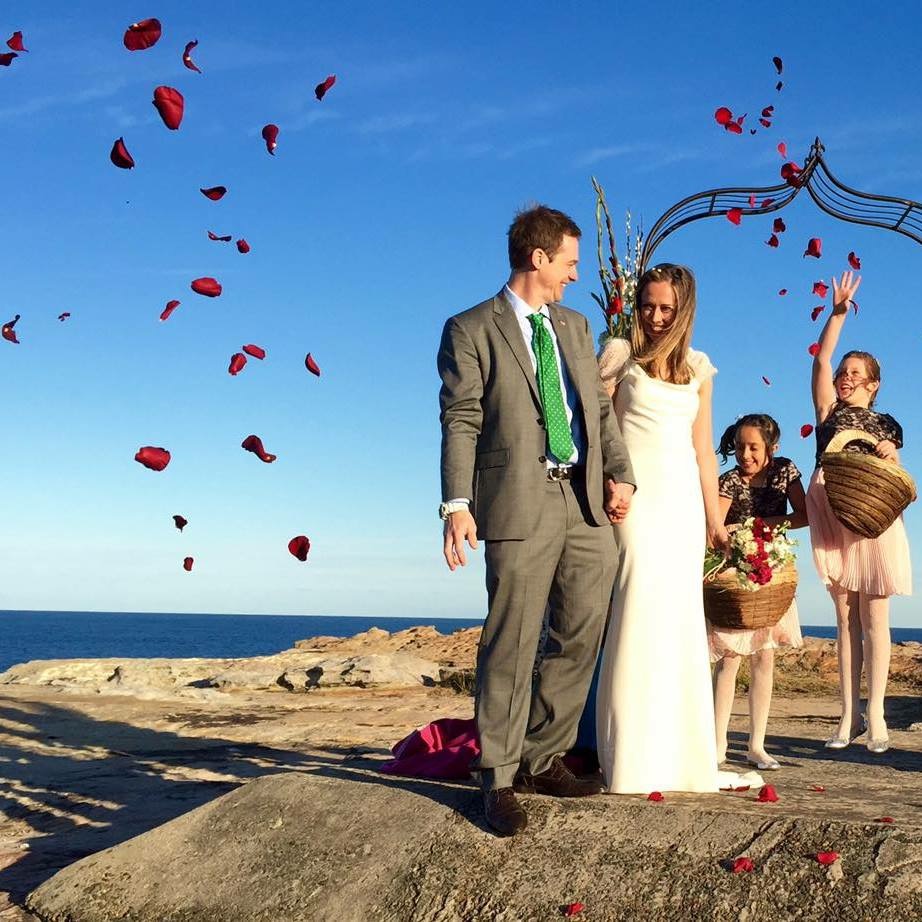
Celine & Iain came all the way from Scotland to get married at Stricland House, Vaucluse

Brides Know Best

A blog where brides share their tips and wedding wisdom

Gavin & Circle get married at Observatory Hill, Sydney


Child-friendly wedding tips

Another article from Examiner.com

A surprise wedding

An article from Examiner.com about a surpise wedding. Of course a surprise wedding can only be a surprise to the guests!

Stone ceremony with unity bowl


At Yuki and Andrew's wedding, guests all added a polished stone to their glass vase. The stones symbolised the uniting of the families and the blessings of all the family and friends.

Unity Candles


At Garry & Coreen's recent wedding at Elizabeth Farm, Parramatta, they had a beautiful Unity Candle table set up.
The couple, and their parents, lit the candles during the wedding ceremony.

from the Sydney Star Observer - same sex couples closer to legal recognition in Tasmania

Marriage in Australia makes the news in Abu Dhabi, UAE

Identify Theft and Marriage

from The Sydney Morning Herald, Saturday 19 September, 2009

5 Rules that Unlock Secrets to a Great marriage

5 rules that unlock secrets to a great marriage
Do things together, be a united front, fight fairly — and have plenty of sex

1. Do things together. We’re not just talking dishes. Hobbies stimulate your brain and boost creativity, and by sharing them, you’re also building a connection that will encourage intimacy. A weekly tennis date is fun, but also mix in some new activities. (Wine-tasting class, perhaps?) “New experiences can give you a high that’s similar to sex,” says TODAY contributor Dr. Gail Saltz, author of “The Ripple Effect: How Better Sex Can Lead to a Better Life” (Rodale).

2. But also do things separately. Don’t give up your book club or Thursday night drinks with the girls just because you’re getting hitched. Devoting time to hobbies and friendships that are solely yours helps you maintain your individuality and express yourself as someone other than “Mark’s wife.” And widening your circle helps guard against feelings of loneliness, which can arise even if you’re with someone. “No marriage is an island,” says Laurie Sue Brockway, a New York interfaith minister and columnist for Wedlok.com. “Too much time together can make a couple feel isolated from the rest of the world.”

3. Don’t diss. Always show respect for your partner, both publicly and privately. If you’re constantly knocking your husband in front of friends for, say, his tendencies to procrastinate or watch too much football, you’re demeaning both him and your marriage. And when letting off steam, “Don’t reveal intimate details, like sexual problems, to someone who’s friends with both of you,” says Saltz. “Think carefully before you speak.”

4. Maintain a united front. Are your in-laws insisting that you visit every holiday or buy a house close to them? Don’t make any promises until the two of you have talked. “Family pressures can weaken relationships, so you’ve got to talk privately about big decisions, then stand together when filling everyone else in,” says Brockway.

5. Fight fairly. “Disagreeing is a healthy part of any relationship, because it’s actually a way of communicating,” says Saltz. But keep it civil — no name-calling or recounting past offenses. Saltz suggests taking a break (like a walk alone) to cool off before you say something you’ll later regret. Insults tend to stick in our memory, and you don’t want the words “worthless, lazy wuss” lingering in his brain for the next 50 years.

Sexual healing
Why a roll in the hay will keep your relationship healthy:

1. You’ll feel closer. Even hours after sex, couples still feel linked, which translates to a great sense of intimacy.

2. You’ll talk better. Thanks to what she calls, “Happy hormones,” Brockway says, being physically close makes partners more eager to communicate with each other.

3. You’ll gain confidence. “Your sexual self is a vital part of who you are, and if you’re in touch with that, you’ll feel more self-assured in other areas of your lives,” says Saltz.

— Lexi Dwyer


This content originally appeared in Brides magazine.

Marriage More Popular than ever from ABC news


Australian marriages making a comeback
By Simon Santow for AM
Last year the number of couples tying the knot reached a 20-year high. (www.sxc.hu: Anka Zolnierzak)
For a while it seemed that if you ever heard marriage mentioned, all the talk was about how unpopular it was.
But the latest figures from the Australian Bureau of Statistics (ABS) reveal the institution has been making something of a comeback in recent years.
In fact, last year the number of couples tying the knot reached a 20-year high.
And on top of that, 2008 was also a very good year for the longevity of relationships, with divorce rates at their lowest in a generation.
The Rector of Applecross Anglican Church in suburban Perth, Reverend Andrew Williams, says you cannot beat an aisle, a choir, some nice flowers and the presence of God for a good wedding.
Reverend Williams might see a few couples as they prepare to embark on married life but he also knows that organised religion is fast losing its grip as the natural home of marriage.
The national vice-president of the Australian Federation of Civil Celebrants, Maxine Lowry, says celebrants have always known that marriage has never really gone out of fashion.
"I wonder, when we live in uncertain times, that people value tradition and value things that are very grounding and things that do bring certainty," she said.
The latest ABS figures reveal celebrants now officiate at two-thirds of all marriages.
"I think if you can choose how you marry, where you marry, if you feel like it's about your commitment to one another and you can say the things you want to say, I think that says a great deal for what motivates people," Ms Lowry said.
"Most of the couples that we do meet have known each other for a considerable time, just about all of them are living together in relationship."

Fewer divorces
Last year was the best year in 20 for marriages, with 118,000 registered and 47,000 divorces were granted in Australia.
It is now taking, on average, more than 12 years before relationships become unstuck.
The national vice-president of Relationships Australia, Anne Hollonds, sees some benefits in couples taking their time before getting married.
"Divorce rates are certainly trending in a positive direction, that is downwards, and I think what that's about is that basically we're much more cautious about marrying anyway, and we're also now much more knowledgeable about the negative effects of divorce than we used to be," she said.
"There's been a lot more research that's been publicly discussed in the last decade, particularly about the negative effects on children.
"We've seen the average age of first marriage creeping up over those years as well, and that's a lot to do with the higher levels of education that we're engaging in now."
If you are contemplating joining the rush towards marriage, a handy hint for the wedding planning: remember November is officially the most popular month, followed closely by March and October.

Weddings Weather the Financial Storm from the Sydney Morning Herald

Weddings weather financial stormCHRIS ZAPPONE
August 25, 2009
The global financial crisis is so far proving no match for the wedding plans of Australians, causing only a modest nod to thrift.
The average wedding cost $31,948 this year, down 4.2 per cent from $33,349 in 2008, with spending set to recover much of the drop within a year, according the research from IBISWorld.
''IBISWorld is forecasting the average wedding spend will rise next year to $33,010,'' said Mr Robert Bryant, general manager IBISWorld Australia.
''The industry overall was worth $3.9 billion in 2008, which will fall to $3.7 billion this year before largely recovering in 2010 to produce revenue of $3.8 billion. Basically, weddings are still big business,'' he said.
Couples are prepared to pay for the custom-made wedding dress, with skimping - if any - limited to spending on receptions and fancy extras, Mr Bryant said.
''This might mean trading the horse and carriage and flock of live doves for a Commodore and confetti,'' he said
Portfolios squeezed
Mr Bryant said the slumping share portfolios, particularly among the parents of the brides and grooms, is the key factor that pulled down the wedding expenditures this year.
''Booking for next year should be coming around now but they're not coming as fast as expected,'' said Alan Woo of Akwoo Photography in Melbourne.
Mr Woo said this current year's bookings happened ''very fast.'' Nonetheless, there are still similar numbers of people visiting the company's website.
Meanwhile, shifting social patterns are also giving couples more flexibility when timing their nuptials.
''Around 76.8 per cent of Australian couples live together before tying the knot, taking the pressure off hurrying into marriage,'' IBIS's Mr Bryant said.
''This means more and more couples are delaying their big day until the financial time is right, so while the current crisis may see some couples think twice before setting the date, those who already have plans in motion will persevere.''
Although the economy is not growing at the pace seen before the emergence of the financial crisis, companies that sell wedding services may ''be more inclined to offer better deals on everything from dresses to cakes.''
Mr Woo said he has noticed more people are buying DVD packages of their weddings, rather than the printed photos as well.

czappone@fairfax.com.au

Research Findings on Marriage and choosing a marriage partner

Wedding Rules - Are some made to be broken?

Chinese Gardens, Darling Harbour, Sydney


Visit BridalTweet: The Engaged Wedding Community


A light-hearted moment when Michelle & Jeff got married at the Chinese Gardens, Darling Harbour, Sydney

Engagement 101 - Online Magazine about getting engaged

Do we want to bring back "guilty party"divorce laws?

Is Marriage a Lifetime Commitment?

Exchanging vows as couples shun religion in favour of civil ceremonies

What We Can Learn From Our Parent's Marriage

Sheri & Bob's Marriage Blog

More recent weddings at Jenolan Caves, Clark Island in Sydney Harbour & Chapel Hill Retreat


Weddings in the Blue Mountains, Jenolan Caves & Bilpin, & on Sydney Harbour

New Rules for a Good Marriage

An interesting article that looks at myths and realities that make a marriage stronger.

Are we getting married today

video

The Seven Stages of Marriage

Book is good news about marriage in later years

Book is good news about marriage in later years article by Peter King pwking@aol.com
March 14, 2009
Love means never having to say you've grown tired of each other

Your marriage may not be a fairy tale, but chances are you are living happily ever after.

That is the conclusion of journalist and author Maggie Scarf, who interviewed 75 couples between the ages of 50 and 75 for her new book, "September Songs: The Good News About Marriage in the Later Years" (Riverhead Books, $24.95).

"I expected people to be having terrible complaints about their kids and their situations, and being crotchety, and I found people who were engaged and alert and enjoying life," Scarf said.

It's not as if the marriages have always been perfectly blissful. Most of the couples have weathered icy patches. "Every marriage has a downside, a time when you looked across the room and thought, 'Oh, my God, what is it with this person?'" Scarf said.

This is a normal progression in the U-shaped trajectory many marriages take, according to Scarf. "You get married, you're at the high point of that U curve." But soon, the demands of raising kids and building a successful life add stress and the couple heads to the bottom of the U curve.

This is often when marriages begin to fail or at least become tattered. But if a couple works through the problems, there are better times ahead as the kids begin to leave the nest. "The couple starts to have more time together, they start to refind each other, to have more of sense of intimacy and fun together, and so you get back to that initial high point," said Scarf, who has been married for 55 years. It is during this time the couple enjoys what Scarf calls the bonus years - the gift of a longer and healthier life due to the increase in life expectancy.

Couples still had arguments, but they were fairer and shorter. "They were arguing about the same things, but there wasn't that sense of rage, there wasn't a sense of tension," she said.

Scarf asked each couple about their sex life, and the spectrum swung between those who were as active as they were early in their marriage to those who were no longer having sex. Even those with less active sex lives maintained an emotional and physical closeness.

Overall, the secret of a long marriage seems to be that the couples realized that staying together would make them happier and healthier than being apart.

"What keeps a marriage together is a very mysterious kind of a glue," Scarf said.

Ten Tips for your Master of Ceremonies

Master of Ceremonies at a wedding: Ten tips on how to be a good Master of Ceremonies, by Rachel Green.

http://www.rachelgreen.com/masterofceremonies.html
You've been invited to be the master of ceremonies at a wedding. What an honour. It is an important job. You know the master of ceremonies can make or break the wedding reception, and you need to be good. Here are ten tips, out of the many available, to help you be a brilliant Wedding Master of Ceremony.
Keep everything flowing smoothly.
It is often your job to mastermind the entire wedding reception. You need to know exactly what is to happen when, where and with whom. However, things are always in danger of going haywire at a wedding reception. When events do not go to plan you have to provide a way for everything to continue to run smoothly. This may be by your filling the gaps in the program or by getting someone else to do it. But whatever happens make sure the wedding reception flows smoothly. You are to smooth everything over.
Keep everything and everyone to time.
How easy it is for a wedding reception to drag on. People speak far longer then they should, the bride and groom are late arriving, the knife for the cake cutting goes missing, the bride's mother faints ... there are any number of possible events that can stop the ceremony going to time. As the Master of Ceremony at the wedding your job is to make sure everything runs to time. If this means you go to the kitchen 15 minutes before the cake is due to be cut to ensure the knife is available and the cake ready, then you go to the kitchen. If you need to talk to everyone in advance about the length of their speeches and how to help them stick to time, then you talk to all speakers in advance. You do whatever you need to keep to time.
Get the introductions and protocol correct.
The Wedding Master of Ceremony is often responsible for announcing who people are and introducing them before they give a speech or a toast. Make sure you have sufficient information on all the relevant people, and that you know what they are doing and when. Ensure you get the titles and protocol correct for all the duties including the introductions. For example, the Master of Ceremonies announcements may include introducing a toast to the bride and groom, calling upon the groom and bride to respond, inviting the parents of the groom to speak, inviting the bride and groom to the dance floor for the bridal waltz, and so on. Work out carefully, in advance, exactly what is expected of you. Your Master of Ceremonies duties can vary from one wedding to another. No two weddings are identical and not everyone wants a traditional wedding. (Also, it is important if you are not also the Best Man that you know which duties the Best Man will take responsibility for and which ones you, as the Master or Mistress of Ceremonies, will do. )
Leave everyone feeling proud of the "happy couple".
Emotions are a very important part of your job. As the Master of Ceremonies at a wedding it is very important that everything you do is geared to two emotions: pride and happiness. You need to ensure everyone at the wedding, particularly the parents and siblings of the bride and groom, glow with radiant pride throughout the wedding ceremony and wedding reception. There are many ways to do this, e.g. telling positive stories about them, finding others to tell relevant stories about them, praising the bride and groom, commenting on good features that are happening... do what you can to leave everyone feeling proud of the couple and proud to have been at the wedding.
Build up happiness.
Help the bride and groom to leave feeling very happy. As their Master of Ceremonies the bride and groom will want you to help them take away a wonderful set of memories that will last them a lifetime. People cherish their wedding photos for years and years; they still talk about their wedding 10, 20 or 30 years later, and they want everything to go well so they can savour each moment. The happy memories matter. The Master of Ceremony needs to have the couple and their happiness as a major focus.
Encourage laughter.
Relax the wedding guests. Relax the bridal party. Relax everyone there by using humour so people laugh. You may for instance tell funny stories, or encourage others to do so, about the couple. This can keep a wedding light and enjoyable. Do not make the stories too embarrassing though, the Master of Ceremonies is not there to humiliate anyone, even if the groom is your best mate!
Help the guests feel comfortable and connected.
One of the difficulties with wedding ceremonies and receptions is that the guests do not know each other. One of your tasks as the Master or Mistress of Ceremonies is to help the guests feel comfortable and connected. Very often guests can feel awkward and alone: bring everyone together. Help everyone get to know each other. This is even more important if it is a cross cultural or cross religious wedding.
Make sure everyone knows what is happening.
So often I have been to weddings, as a guest, and had no idea what is happening next, or where I am to go or what I am to do. As the Wedding Master of Ceremony do not let this happen to your guests. Do not leave your guests standing around not knowing what to do next. Tell them what is happening each step of the way.
Do not crack irrelevant jokes.
Master of Ceremonies who are new to the role, often make the mistake of thinking that they have to tell a whole series of jokes. There is no need to. There are other ways to produce humour. If you do tell jokes make sure they do not offend anyone. Pick them very carefully indeed.
When alcohol is present be prepared for anything.
Sadly, people who drink too much alcohol at wedding receptions can cause a nightmare for the Master or Mistress of Ceremony. However, the Master of Ceremonies (usually along with the Best Man) is responsible for managing crowd behaviour. You become the unofficial bouncer. was It is your job as the Master of Ceremony to avoid unpleasant incidents from occurring and if they do, to deal with them swiftly and discreetly so there is as little embarrassment for the bride and groom as possible.

Further information
Want to know more? Got your wedding coming up soon? Then there is an E-book you can get immediately that is packed full of many more practical tips on how to be a superb Master of Ceremonies.

It contains a whole special section on "How to be a brilliant master of ceremonies at a wedding"; and there are also an additional "Ten tips for wedding MCs from a DJ's viewpoint", by Adrian Makarov, a professional DJ at weddings from Goldbass Records.


A Master of Ceremonies: A beginner's guide to being a brilliant MC.
Have it delivered immediately to your e-mail box so you can be a brilliant Master or Mistress of Ceremony at your wedding.


And, as an extra special bonus for you, once you have read the book you are welcome to send any questions you have about being a Master of Ceremonies to me, so I can personally answer them for you. The normal cost of an individual coaching session with me is $247.50 per hour so you are getting this for free.
Go to the website to order- http://www.rachelgreen.com/masterofceremonies.html

Enjoy being a brilliant Master of Ceremonies at your wedding.

Best wishes,
Rachel Green
PO Box 344, Kelmscott, Western Australia 6991.
Phone: +61 8 9390 1188. Fax +61 8 9390 1199
E-mail: rachel@rachelgreen.com


These tips are only general in nature and may not apply to all people, all cultures or all weddings or situations. While every care has been taken to ensure the tips are useful, no responsibility can be taken for the results gained from their implementation. Please seek individual professional guidance for any difficulties you may have in your communication, inter-personal, wedding management or performance skills. Thank you.

Copyright 2008 RachelGreen.Com Pty Ltd
You are free to print out this page for your personal use. If you would like to incorporate these tips into any publication or use them in any other way, please contact us. rachel@rachelgreen.com

Copyright 2007 RachelGreen.Com Pty Ltd
PO Box 344, Kelmscott, WA 6991 Australia
Phone: +61 8 9390 1188 Fax: +61 8 9390 1199

Recession Sees Marriage Rate Rise

A few recent weddings at Manly, Sydney Botanic Gardens & Cremorne Point on Sydney Harbour


North Head, Manly .......................................................Royal Botanic Gardens, Sydney city


Cremorne Point, Sydney Harbour


Marriage on a budget

Elena & Milan get married at Cremorne Point, Sydney Harbour


Seven Things No One Tells You About Marriage

Lucie & Petr get married at North Head, Manly


North Head, Manly - what a wonderful
setting for a wedding ceremony!

Are you ready to get married, and other articles about marriage

Globe Trotting Bride - a travel & wedding blog

Wedding Customs

WEDDING CUSTOMS
Ever wonder why we do what we do, before, during and after a wedding? The following is a list of some of our most common traditions, customs and rituals with an explanation of their original purpose. Have a look and enjoy!
ENGAGEMENT RING
The engagement ring is a promise for marriage. During the Roman era, the man had to "barter" for his future bride. The engagement ring was security for the "betrothed."
A stone, filled with the "fires of love" is why the diamond has become the symbol of engaged couples everywhere. No other stone can portray the intensity and strength of true love so well.
The ring of gold, a symbol of lasting beauty, purity, and strength, itself has been a symbol of the joining of a man and woman as a perfect union since the Egyptians used it in hieroglyphics to portray eternity. A never-ending circle, a perfect symbol for an everlasting love of the heart.
The Romans furthered this tradition by choosing the third finger on the left hand as the place for this most special ring. It was believed that the "vena amoris", the vein of love ran from this finger directly to the heart.
BACHELOR PARTY
This was the last chance before his new wife took over the finances for the groom to gather money by gambling for his own future use.
BRIDAL SHOWER
This custom came about when a father disapproved of his daughter's marriage and refused to provide a dowry to the couple. The shower became the alternative to the dowry. Supportive villagers would assemble and provide the bride a variety of household items for her new home.
DOWRY/HOPE CHEST AND TROUSSEAU
There was a time when marriage would include some exchange of property between the families of the bride and groom. The groom's family would pay a price to the bride's family for the bride. The bride's family in turn would provide the couple with a dowry of various household items for their new home. As a bride planned for her future marriage, she would supplement this dowry with her own items that she collected or made (i.e. embroidered linens).
All items would be kept in a special Hope Chest built by the bride's father for the purpose of holding the dowry. The trousseau included all the clothing and property which a bride brought with her to the marriage. Today, the trousseau includes all wedding and shower gifts as well as new purchases.
SOMETHING OLD, SOMETHING NEW...
You may have heard the saying that the bride is to wear "something old, something new, something borrowed and something blue." Each part of this saying holds some form of traditional significance. The old and new items represent the passage from the single status to the married status. If the bride borrowed anything from a happily married woman, it was thought to transfer her good fortune and joy to the soon-to-be bride. The borrowed item represents the participation and approval of the wedding by family, friends and the community.
Something blue is a symbol of purity, love and fidelity. In England, this saying goes on further to include "...and a lucky sixpence in your shoe" which brides will still do.
These customs are thought to be ancient Hebrew traditions. Also found written that this 'old English rhyme' symbolizes continuity, optimism for the future, borrowed happiness, and fidelity and good fortune.
BRIDAL VEIL
Traditionally the bridal veil was a symbol for modesty, respect and virginity. The veil served as a reminder to all witnessing the ceremony that the physical relationship was entered into only after the vows were exchanged and the marriage became official with the seal of a kiss.
The veil was removed after the vows were exchanged and the couple was pronounced "Man and Wife." The Veil was long a symbol of youth and virginity and was used to ward off evil. The Colour Red was for defiance, the Colour Yellow for Hymen, the goddess of marriage.
Later, it is said, Nellie Custis, Martha Washington's daughter, was the first to wear the now traditional white. All because her suitor complemented her beauty while she stood behind a lace window curtain!
WEDDING RING
The marriage ring represents a promise for eternal and everlasting love. It is a representation of the promises joining both the bride and groom together. The wedding ring is placed on the third finger of the left hand because it was traditionally believed that this finger was a direct
connection to the heart -- the perfect place to place a symbol, representing eternal love and commitment.
BUDS AND BLOSSOMS
For centuries, flowers and greenery have accented bridal parties around the world. Certain flowers, such as the rose, lilies, myrtle, and ivy are Victorian symbols for love, fidelity, and marriage.
Roses - Love
Lilies - Purity
Spider Flower - Elope with Me
Lily-of-the-Valley - You've Made my Life Complete
KISS ME!!!
The Kiss was actually the legal bond that sealed all Roman contracts, including marriage. It was also the belief that when they kissed, a part of one's soul was left in the other in the breath that was taken.
THE WEDDING CAKE
The wedding cake, in Roman times, was broken over the bride's head to wish the couple a life of plenty. Guests would gather crumbs for good luck.
In Medieval England, the Multi-tiered wedding cake was conceived from the tradition of the guests of the bride and groom bringing small cakes for the reception and placing them in a pile on a table. The bride and groom were to kiss for good luck over the cakes. To help keep the pile together, the cakes were iced to each other, making the first tiered cake.
THE BRIDAL PARTY
To fool demons that might take away the joy of the bride and groom, their friends dressed similarly to them. If the evil spirits were unable to tell them apart, then any woe would not befall the newlyweds. It is also written that long ago the groom would be accompanied by his friends to help kidnap his bride and defend him from anyone who might stop him, or worse, try to steal her away! In later more "civilised" times, the bride travelled to the groom’s home with her escorts, the bridesmaids, who protected her, and the dowry, from robbers.
A BRIDE OF WHITE
Purity is always the forethought to people when they think of a bride dressed in white; however the Ancient Greeks and Romans used white in many celebrations to signal joy. According to some writings, Greeks even painted their whole bodies white for wedding celebrations!!
There was a time when the bride would wear her favourite dress to the ceremony. In 1840, Queen Victoria wore an elegant all white gown to her wedding. She started a fashion trend which quickly caught on and continues to this very day. White was worn because people believed it represented affluence, virginity and purity.
ALTAR POSITIONING
This tradition dates back to the time when marriage might take place by capture.
By having the bride stand to the groom's left, the groom would have his right hand free for his sword if he needed it for defence.
ARCH OF SWORDS FOLLOWING CEREMONY
Walking through the arch of swords following the ceremony was done to ensure the couple's safe passage into their new life together.
BREAKING OF GLASS
A Jewish tradition that represents the destruction of the temple in Jerusalem.
Many times, couples saved the pieces of glass from the ceremony in a special symbolic box.
CHILD ATTENDANTS
Children were originally included in the ceremony to add innocence.
FATHER GIVING THE BRIDE AWAY
This custom originally had its roots in arranged marriages where the bride was considered property. Later, this custom persisted as a symbol with two meanings: an endorsement by the father to all witnessing the ceremony that the groom is the best choice for his daughter. an offering to the groom: "I am presenting to you my daughter."
FLOWERS AND THE TOSSING OF THE BOUQUET
Flowers were incorporated into the ceremony because they represent fertility, purity, new life and never ending love.
Traditionally, bouquets were a mixture of flowers and herbs.
Dill was a very popular choice as an herb because it was believed to promote lust.
Following the ceremony, the dill was eaten for that purpose.
Tossing of the bridal bouquet is a custom which has its roots in England.
It was believed that the bride could pass along good fortune to others.
In order to obtain this fortune, spectators would try to tear away pieces of the bride's clothing and flowers.
In an attempt to get away, the bride would toss her bouquet into the crowd.
Tradition says that the unattached woman who catches the bouquet is the one who receives the bride's fortune and will marry next.
GROOM ENTERING FIRST/ GROOM EXCHANGING FIRST VOW
Both of these customs signify that the groom is the covenant initiator. Because he is the initiator, he is the first to state his vow for marriage. As the initiator of the covenant, the groom is to assume the greatest responsibility in the marriage.
HUPPAH
In the Jewish religion, the ceremony takes place as the couple stands under an ornamental canopy. This canopy symbolized nomadic tents of Israel and the new home that the couple would soon share.
RECEIVING LINE
This is a chance for the guests to congratulate and greet the newly married couple and their parents.
RECEPTION, FOOD AND WINE
The reception is the official celebration of the new couple. The wedding cake represents the sharing of the bride and groom's body to become one. The drinking of wine symbolizes the sharing of the bride's and groom's life together with God.
SIGNING OF WEDDING PAPERS AND THE SIGNING OF THE GUEST BOOK
The signing of the marriage certificate documents a public record of the marriage. The guest book was a record of all people who witnessed the wedding. For that reason, the guest book is supposed to be signed following the official wedding ceremony.
THROWING OF THE GARTER BELT
This ritual dates back to a time when woman wore hose with a garter belt. It was a chance for the single men to share in the good fortune of the groom.
Today, it is believed that the man who catches the garter when it is thrown will be the next to marry.
THROWING OF RICE, FLOWERS
When thrown as the couple exited the church, throwing of rice and flowers represented the wish for the couple to have a fruitful and plentiful life together. Originally rice and wheat were thrown over the married couple to represent the hope for fertility. When rose pedals are thrown before the bride as she walks down the aisle, it is to ward-off evil spirits below the ground and grant fertility.
UNITY CANDLE
The unity candle is a symbol of family unity. Usually a single candle (representing the newly married couple) is lit with two individual candles, each representing the bride's and groom's families.
WEDDING MEMENTOS
Wedding Mementos are mementos of the special occasion given to each wedding guest to thank them for sharing the momentous occasion with the bride and groom.
CARRYING THE BRIDE OVER THE THRESHOLD
This was done to protect the bride from any evil spirits which may be hiding beneath the threshold. The groom would carry his beautiful bride to safety and happiness so they could start their new lives together.
THE GRAND EXIT AFTER THE RECEPTION
Traditionally, old shoes were tied to the back of the car to represent the transfer of property from the father of the bride to the groom. Horn honking, the shooting off of firecrackers and ringing of bells were a means to protect the bride by warding off evil spirits.
THE HONEYMOON
The couple would spend a "honeymoon", that is, one month, or from full moon to full moon, to be alone together without all the responsibilities that come with marriage. While together, they would drink a type of "honey wine", as honey was the ancient symbol of life, health, and fertility.
SHIVARE This custom dates back from the Middle Ages. A group of friends would gather and bang on pots and pans shoot off guns, etc. to disturb the newlywed couple on their wedding night.
INTERNATIONAL TRADITIONS
Following is a list of traditions, customs and rituals throughout the world. Some of these are still followed at weddings today.

If an English bride passed a chimney sweep on her way to the church, and the chimney sweep kissed her, it was considered good luck.

In Holland and Switzerland a pine tree, a symbol of fertility and luck, was once planted outside a new couple's home.

In South Africa, both bride's and groom's parents carried a fire from the hearths of their own homes and took this fire to the new couple's home to begin the fire in their home.

In Armenia, two white doves were set free to symbolize love and happiness.

The wedding cake in Bermuda was a multi-level fruitcake and included a small cedar tree on top. This tree was planted and is supposed to grow with the love of the bride and groom.

In Japan, brides change their bridal attire several times throughout the wedding day.

In England, the bride wouldn't allow her married name to be used before the wedding for it was considered bad luck.

In Italy, the groom's tie was cut into pieces and sold to the guests at the reception. The money earned is used for the honeymoon.

Flowers decorated the front of the bridal car in Italy so that the bride and groom would have happy travels throughout life together.

In Japan, ducks or a goose and gander were included in the processional because they mate for life and are a symbol for fidelity.

In Poland, guests paid to dance with the bride and this money is used for the honeymoon.

During the reception in Spain, wedding guests danced a special dance and then present gifts to the bride.

An early American custom -- the bride pinned a small pouch to her wedding petticoat.
This pouch contained a small piece of bread, cloth, wood and a single one-dollar bill. This ensured that there would be enough food, clothes, shelter and money for the future couple.

Marriage Busters & Marriage Builders

Two Become One from the Korea Times

http://www.koreatimes.co.kr/www/news/art/2008/11/148_34220.html

Mona and Ray get married at Balmoral